The balancing act of scaling through an ecosystem
By Thomas Feeny, Director of the IDIA Secretariat
This is part two of a three-part blog on how the insights, tools and models pioneered by members of the International Development Innovation Alliance (IDIA) are helping agencies “Meet the Moment” of scaling in the new world order. Part one explored the fundamentals of developing or refreshing a scaling strategy, including key frameworks and insights curated by the IDIA ecosystem. And this blog — part two — dives into the practice of scaling through an ecosystem lens. It also explores mobilizing the public sector through IDIA’s widely adopted “Mountain Model,” and highlights new approaches to collaborative scaling among innovators. Part three will introduce an exciting new ‘Capital Continuum’ model being developed by IDIA to help provide more appropriate and predictable financing for entrepreneurs navigating scale-up, alongside insights from the IDIA ‘Investors & Enablers’ community on building partnerships for scale.
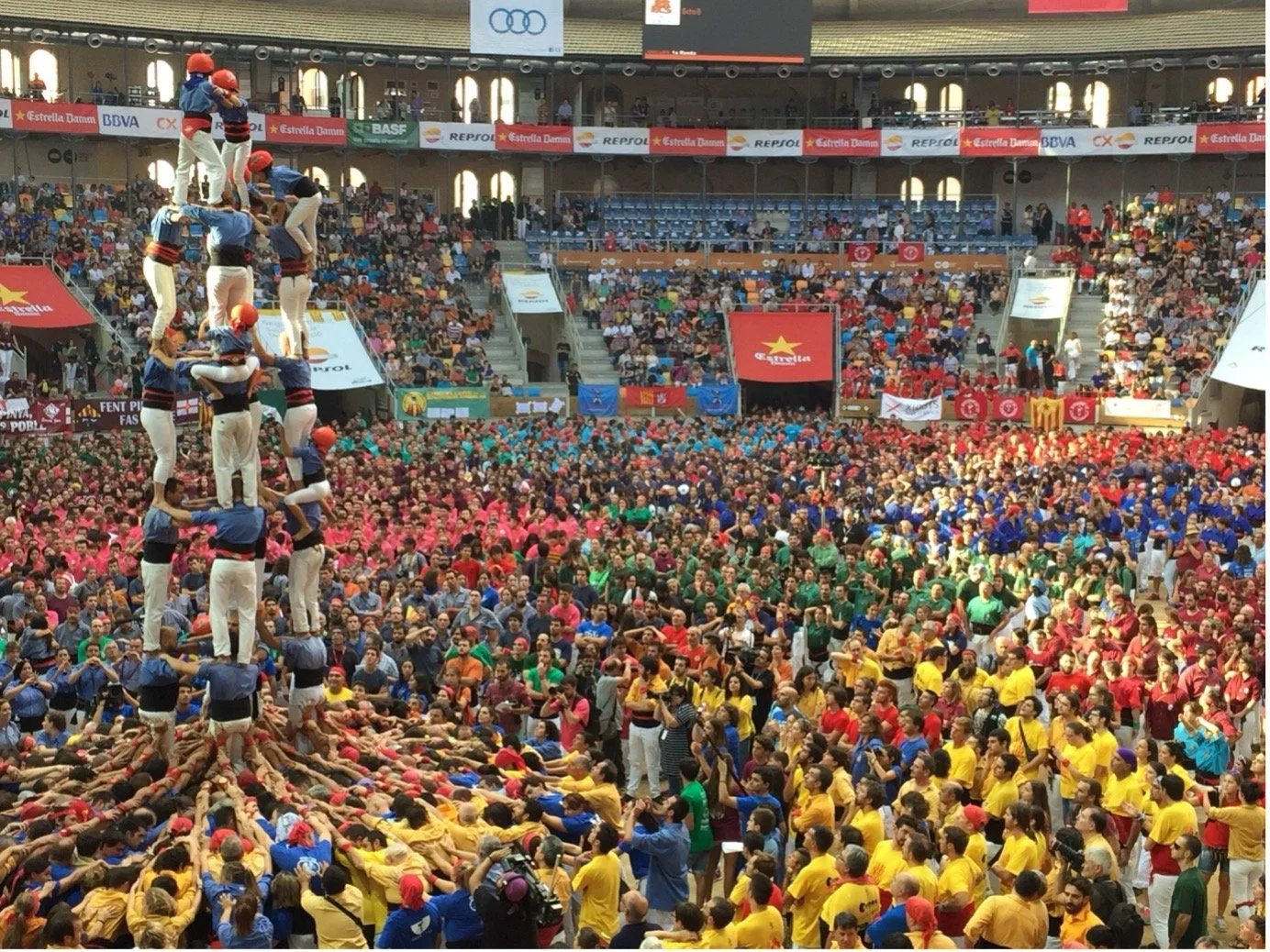
In 2015, I remember watching spellbound as fearless men, women and children from villages across the Catalonian region of Spain competed to build the tallest human towers in the biennial Concurs de Castells festival. As my holiday snapshot above shows, the arena was filled with people from all ages and backgrounds coming together, perfectly balancing their respective levels of strength, agility and courage to create an awe-inspiring structure 6-10 levels high.
It was no coincidence that two years later, this very photo became the front cover of IDIA’s Insight Guide on Scaling Innovation — illustrating as it does so perfectly the act of balancing risk, creativity and resources across multiple actors that characterizes the challenging process of scaling innovation.
People are at the heart of whether an innovation scales or fails. Even the most technologically-advanced or AI-enabled solutions still depend on the carefully choreographed contributions of human designers, funders, doers and adopters (to name but a few roles). This is perhaps why, as a people-focused enterprise, it’s not been particularly surprising to me to see the lively community debates around the scaling agenda that continue to unfold in the weeks since I launched part one of this blog series. Today, you have one corner advocating that scaling should be the raison d’etre of the development community, or the ‘impact jackpot’ — while in another corner you are told that scaling is nothing more than an elusive ‘myth’, ‘perpetually on the horizon’ and ‘always promised but never delivered.’
As usual, the truth lies somewhere in between — and the most pragmatic way forward draws on both perspectives rather than picking a side.
We learned this very early on in the evolution of IDIA, when an initial mapping of “scaling” definitions across our member agencies surfaced a multitude of interpretations and approaches, sometimes within the same organizations. What quickly became clear was that trying to coalesce everyone around a single model of scaling would be impossible. And, more importantly, it would undermine the reality that everyone comes with different capacities, risk appetites, interests and opportunities. In fact, the goal of creating the IDIA Scaling Framework was not to try and impose a Lord of the Rings-style “One Tool to Rule them All’ but rather to create a bridging platform to help different actors situate their respective scaling models in a way that would make visible their particular contributions, surface gaps and stimulate new collaborations as a result.
Eleven years on, we still hold firm to this principle — that as a collaborative process, scaling is about helping different actors explore and enhance their particular contribution to impact in partnership with others.
Part two of this blog series continues our journey of sharing key tools and frameworks IDIA has co-created over the last 10 years to help diverse actors orient and articulate their scaling approach. Specifically, it highlights the IDIA Ecosystem Strengthening Framework as a foundational tool, while also diving deeply into how the Mountain Model, a pioneering new approach co-created by IDIA with East African members, is accelerating the scale up of innovation through the public sector.
Country innovation ecosystems as essential infrastructure for scale
Scaling solutions and strengthening innovation ecosystems are two sides of the same coin. They are both essential, interdependent ingredients to successful, sustainable impact. Yet for a long time, the proliferation of funder-favourite models such as challenge funds meant that the focus was predominantly on supporting individual solutions, with the underlying assumption that sufficient funding would then naturally lead to scale.
But with only a tiny proportion of these innovations reaching meaningful impact, it became clear that capital was just one piece of the puzzle. Policy frameworks, communications infrastructure, innovation culture, risk appetite — all of these shape the scaling journey too. As a result, an increasing number of actors, including country governments, are now responding by integrating an ecosystem lens into their scaling strategy and programming
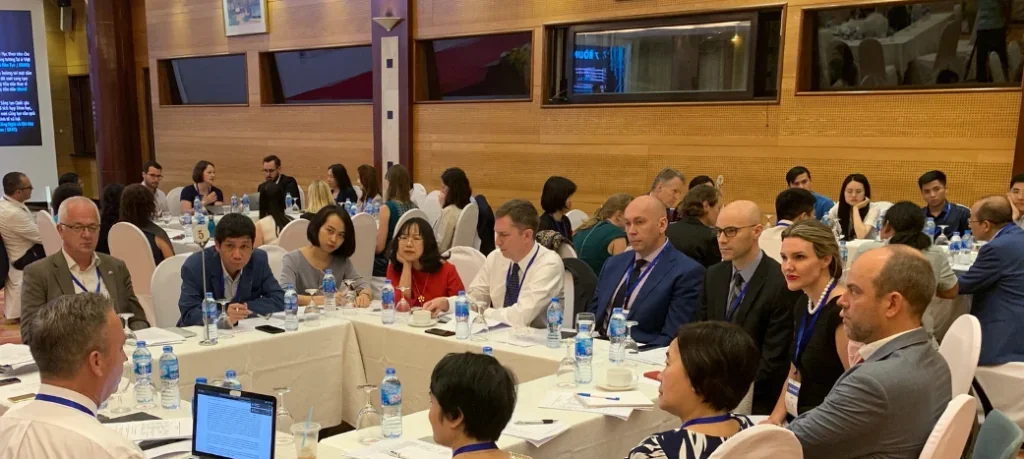
The IDIA Ecosystem Strengthening Framework grew out of years of collective learning contributed from our Global Innovation Advisor community and through a mix of contextual research, case studies and multi-day in-country IDIA convenings with ecosystem actors in contexts as diverse as Kenya, Vietnam, Ghana and India. IDIA then mobilized an Ecosystem Strengthening Working Group to translate and package this learning into a comprehensive definition of an ‘innovation ecosystem’, identifying the roles and contributions of different actors, and providing an accompanying framework outlining 9 priority goals for action.
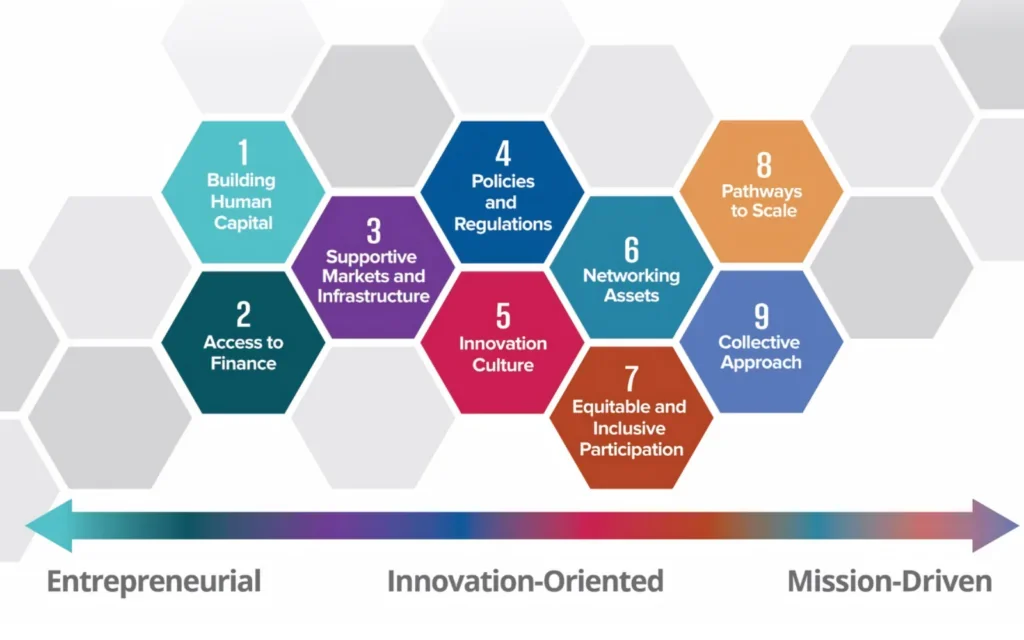
IDIA’s support for ecosystem strengthening approaches has proven highly influential across the global development community, helping different actors contextualize and expand the way they support the scaling process. For example, in 2021 the IDIA was used by the UK Foreign, Commonwealth and Development Office (FCDO) as the backbone of a five year, £32m Research & Innovation Systems Africa (RISA) Fund, while also prompting Grand Challenges Canada to introduce a brand new ‘Ecosystem Catalyst Grant’ financing instrument within their portfolio. And we are continuing to advance knowledge and practice in this space, as demonstrated by the recent Strengthening Innovation Ecosystems Learning Journey that IDIA undertook in partnership with the OECD.
Of course, strengthening an innovation ecosystem is bigger undertaking than scaling an individual solution — and in an environment of increasingly scarce resources, that ambition will feel daunting to some and downright impossible for others. Yet as with scaling, the key to success is partnership and identifying one’s comparative advantages in order to contextualize a scaling strategy within an ecosystem approach.
For those that would like direct support in this space, I encourage you to apply for the annual IDIA Training on Managing Innovation for Impact, where this ecosystem lens is a key principle in the design and delivery of the content as well as in the composition of the cohort. For others who are keen to roll up their sleeves straight away, here are a few of the pivotal IDIA-related outputs and tools exploring how scaling and ecosystems are so closely intertwined, and what approach might be most impactful for you:
IDIA Innovation Ecosystem Event – Kenya (2018) Documenting the insights from a wide range of actors working within the agricultural innovation ecosystem in Kenya, who convened under the IDIA umbrella to co-create a mapping of roles and responsibilities of different actors in response to articulated priorities and weaknesses of the ecosystem.
Scaling & Systems: An Issues Paper (2021) Produced by the Global Community of Practice on Scaling Development Outcomes (an IDIA Partner Network) and authored by Richard Kohl (a key collaborator with IDIA in creating the Mountain Model for Public Sector Scaling), this paper introduces some of the key linkages between the scaling and system-strengthening agendas. It reflects on a debate within the scaling community on the extent to which systems need to be taken into account in scaling efforts, or even if the starting point for change efforts should be systems change rather than scaling innovations.
IDIA Insights Guide on Strengthening Innovation Ecosystems (2021) This comprehensive resource, co-created by IDIA members and multiple ecosystem actors across Africa provides a conceptual approach for understanding different kinds of innovation ecosystems as well as a practical framework of ‘ecosystem building blocks’ to help country actors and international partners develop more intentional strategies and interventions advancing ecosystem maturity.
Innovation Ecosystem Approaches: A Learning Brief (2025) This short report summarises some of the key insights from the five-year FCDO RISA programme noted above, which utilised the IDIA Ecosystem Strengthening Framework as the backdrop for its efforts to build ecosystem capacity in six countries across Africa: Ghana, Rwanda, Ethiopia, Nigeria, Kenya and South Africa.
What works to strengthen innovation ecosystems in low and middle-income countries? (2025/2026) In 2025, IDIA and the OECD Innovation for Development Facility embarked on a 9-month learning journey to gather evidence, case studies and insights around ecosystem strengthening to help inform strategy and practice. Blogs from each webinar are available on the IDIA website covering factors such as ecosystem diagnostics, indicators, inclusivity, directionality and more. A concluding synthesis paper will also be produced in mid-2026.
Scaling through Government: The IDIA ‘Mountain Model’
“Scaling impact is important, but that doesn’t mean that every organization should strive to be as big as possible. Impact can be scaled in a lot of other ways — through influence, innovation, or new models.”
— Cheryl Dorsey, CEO of Echoing Green (Stanford Social Innovation Review Newsletter, 30 April 2026)
IDIA’s approach to scale very much reflects the diversity of approaches noted here by Cheryl Dorsey. Collective thought leadership to expand the ‘art of the possible’ and challenge underlying assumptions has always been central to IDIA — in particular through the co-design and practical demonstration of new ways of working.
One IDIA’s most influential ‘demonstration models’ focuses on government leadership in the scaling process. And not just by creating an enabling policy environment, but in supporting them to embed strategies and processes to routinely source and scale new solutions within their own public sector infrastructure.
In 2020, the IDIA Secretariat partnered with Insight Health Advisors in Kenya to undertake a comprehensive piece of consultative research exploring demand by public sector actors at all levels (national and sub-national) for innovative policies, products, services and/or ways of working that are designed to improve population health outcomes. Using Kenya as a case study, the report surfaced a range of interconnected factors that were influencing public sector demand for, and scaling of, health innovations, as shown below:
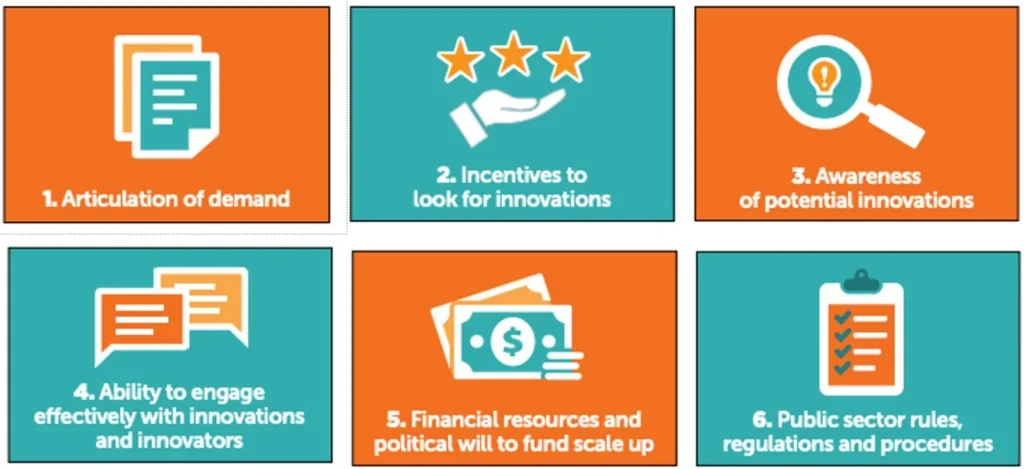
These influencing factors (which are unpacked in detail in the full report) informed the design of a six-stage model that uses a mountain-climbing metaphor to map the support and interventions needed at each stage of the scaling journey. This “Mountain Model” has the following features:
The model describes a locally-facilitated process — with the primary goal of supporting national and local governments in scaling innovations that are aligned with their health priorities. It is deliberately not prescriptive. The only structure it offers is a set of stages, stakeholders and decision points to guide the process.
The Mountain model is designed to be demand-driven: it starts from the priorities and needs that participating public sector actors define themselves, then asks what assistance they would like in identifying, assessing, adopting and scaling innovations to meet those needs.
While created and tested in the context of health, the Mountain Model does not carry any bias towards particular subsectors or issues, nor will it promote or prioritize the specific innovations or interests of any international agency where these do not align with those of the country government.
The long-term, overarching goal of this model at every stage is to identify and lay the foundations for a sustainable, locally owned process for demand and scaling, ideally through institutionalization of the associated roles and responsibilities within the public sector and its partners as appropriate.
Key to this process is adopting an ecosystem approach enabling the government to lead the scaling process by leveraging the expertise and resourcing of other stakeholders to help address barriers as and when they emerge:

THE CHAMPIONS — Country/county governments, innovation funders and international agencies who are interested or mandated in providing overarching resources for activities to enhance public sector demand and scaling of innovation in a particular context / sector.
THE COHORT — A discrete group of national and/or local public officials who share a willingness and ability to embark on a process of improving their uptake and scaling of innovations.
THE GUIDE — An intermediary organization with deep contextual knowledge and cross-cutting networks, who will listen, learn, connect and support the Cohort to different resources and actors at key points along the scaling journey to help overcome barriers. In this way, the Guide provide the critical long-term support to government actors as they encounter inevitable challenges in ascending the mountain.
THE INNOVATORS — A pool of local, national and international entrepreneurs with solutions that can be matched to public sector demand, adapted and mobilized to meet specific policy objectives.
THE SUPPORTERS — A pool of diverse public, private and academic actors from local, national and international contexts who can be mobilized at different points in the scaling journey to provide specialized knowledge, technical expertise, funding tools and/or networks to the Cohort based on the challenges they face.
Six broad stages were then identified that each Cohort will typically need to work through in order to make sustainable progress in sourcing and scaling innovations. Importantly, this process is demand-led rather than imposed or prescriptive, and the Guide will be the key to ensuring successful mobilization of actors and resources to help address whatever challenges emerge along the way.
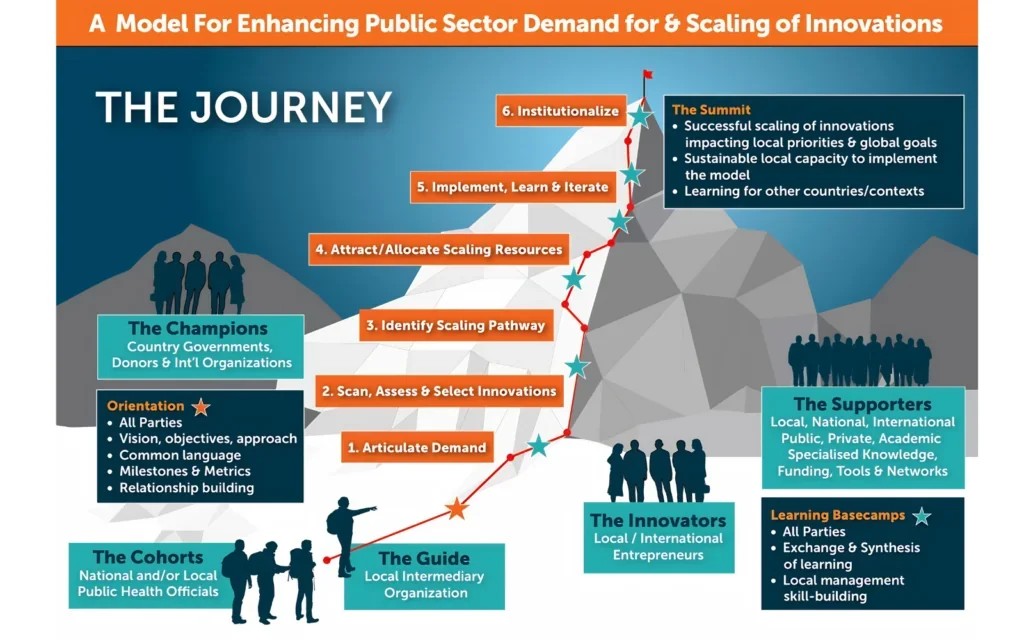
STAGE ONE – Articulate Demand. While most governments have well-articulated policy goals and objectives, these are often not translated into a sufficiently granular level to provide new or existing innovations with obvious entry points to contribute to those goals. This stage involves working closely with national and local officials to agree and prioritise gaps/opportunities within policy targets and frameworks to provide a clearer articulation of demand for appropriate solutions.
STAGE TWO – Scan, Assess and Select Innovations. The focus of this second stage is on helping government actors efficiently scan what it available, assess the pros and cons of different solutions and then make decisions around which they want to adapt/adopt going forward. This will require working in partnership with innovators and supporting institutions to (a) ensure that the necessary cost, impact and adoption information is available and comparable; (b) ensure they are able to clearly explain how their innovations work and how their impact is aligned with goals of concern to policymakers; and (c) articulate the potential of their innovation to accommodate contextual modification and adaptation.
STAGE THREE – Identify the Scaling Pathway. Research suggests that there are three broad pathways for innovations to reach sustainable impact at scale through the public sector: (1) Approval and Accreditation; (2) Purchasing, Procurement and Public-Private Partnerships; and (3) Adoption and Integration. Based on an understanding of the problem being targeted, the specific demand articulated by the Cohort, and the nature of the innovations that have been assessed as potential solutions, the Guide will work with the Cohort and other Supporters as necessary to map out the most cost-effective route to scale within their resource constrained environment.
STAGE FOUR – Attract / Reallocate Scaling Resources. As governments have limited discretionary expenditure or resources allocated to supporting innovation, this stage explores mechanisms such as internal advocacy, political negotiation and influencing development partner agendas to attract or secure resources needed.
STAGE FIVE – Implement, Learn and Iterate Scaling. This covers the continuous need to generate data on the scaling process to inform the model’s possible adaptation in line with changing global, regional, national and local systems, structures and processes.
STAGE SIX – Institutionalize. At this stage public sector actors (or other local institutions as appropriate) can independently drive demand and scaling themselves, with those responsibilities embedded within existing roles and partnerships, or new institutions. This capacity has been built progressively throughout the process — not bolted on at the end.
Over the past five years, the Mountain Model has been shaped by many contributors — including a group of Public Sector Scaling Champions who brought expertise, networks and influence to its refinement. The result: governments have adapted the model to scale up of innovations within public health systems at national and local levels, including in:
Kenya, where it was initially tested in two counties and has since spread to an additional 14 counties under the Lake Region Economic Bloc;
Tanzania, where it was used by the Ministry of Health & Family Welfare to inform the demand-led selection of innovations for development partner investment; and
Ethiopia, where it provided the foundation for the Ministry of Health’s first ever National Health Innovation Guidelines and demand-led innovation articulation process.
At a global level, the Mountain Model has also been used by the World Health Organization as the backbone for the WHO’s first Call to Action for Public Sector Scaling of Health Innovation and for the inaugural World Health Innovation Forum (co-hosted by WHO, IDIA and the Kalam Institute of Health Technology) focusing on public sector scaling that was convened in India in 2023.
This kind of uptake and adaptation is exactly what IDIA aims for through our demonstration models. Throughout our journey, we have shared the milestones, learning and tools developed to support each stage of the Mountain Model — including Innovation Investment Cases and soon a Public Sector Scaling Readiness toolkit for innovators — to help governments and other innovation actors explore how it might help meet their needs.
++
The Ecosystem Strengthening Framework and the Mountain Model are not finished products — they are living tools, shaped by every actor that puts them to use. As governments move to the center of the scaling agenda, IDIA will keep building and sharing what we learn. Browse all of these resources, and more, here.