Our Story
Group formation
When the Millennium Development Goals came to a close in 2015, global action on the world’s challenges was still falling far short of the pace and scale needed to end poverty, promote peace, and secure a more prosperous and equitable planet for all.
With the even more ambitious Sustainable Development Goals coming into play later that year, it was clear that a business as usual approach would not suffice in advancing transformative change, and many development agencies took steps to create and formalize dedicated teams and funding streams exploring how innovation could be applied to achieve better results.
At that time, only a limited set of tools and frameworks had been established to help agencies understand how to support and use innovation in a development context. In response, the Rockefeller Foundation approached Results for Development (R4D) to explore the potential of a knowledge exchange platform for leading development agencies to discuss and share learnings from their innovation strategy and programming.
This led to the senior innovation leaders and Chief Innovation Officers from 10 of the world’s biggest development agencies coming together in February 2015 to launch an informal ‘Funder’s Innovation Group’, facilitated by a small Secretariat team at R4D. These ‘Founding Members’ were:
Australian Government Department of Foreign Affairs & Trade (DFAT)
Bill & Melinda Gates Foundation
Global Affairs Canada (GAC)
Grand Challenges Canada (GCC)
Rockefeller Foundation
Swedish International Development Cooperation Agency (Sida)
UK Department for International Development (DFID)
United Nations Children’s Fund (UNICEF)
United States Agency for International Development (USAID)
World Bank Group
Mission, Purpose & Principles
The founding members of the Funder’s Innovation Group moved quickly to co-create a shared ‘Mission & Purpose” paper in which they articulated their shared objective to ‘actively promote and effectively advance innovation as a means to help achieve sustainable development and the 2030 Agenda, by:
Sharing knowledge, experiences and insights
Identifying and addressing gaps in the innovation ecosystem
Collaborating to develop public goods that support innovation, including pooling resources as appropriate
In the process, they adopted the name International Development Innovation Alliance, and IDIA was born.
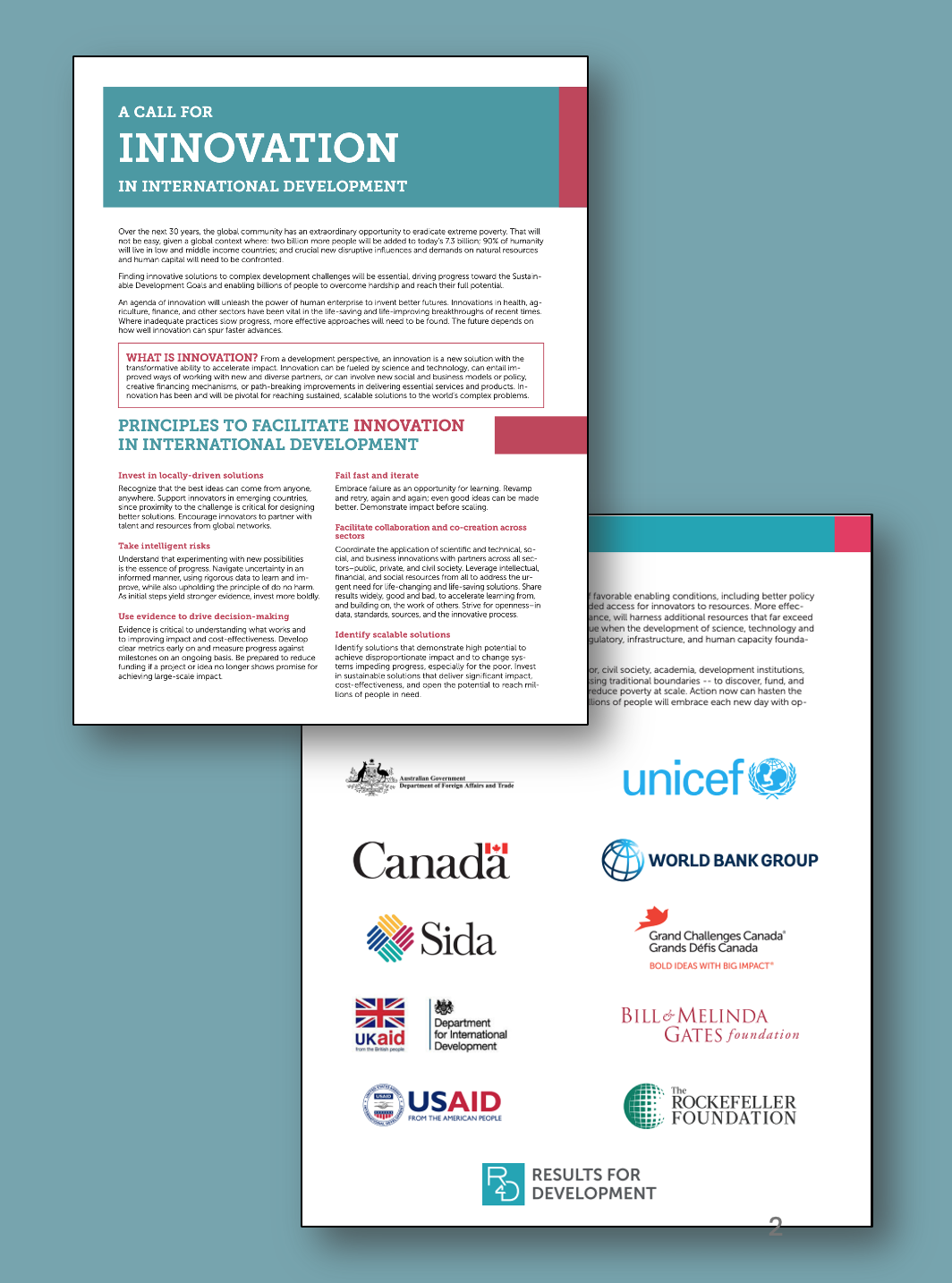
Central to the group’s early priorities was the objective to establish a common understanding of innovation that they could then collectively advance to mobilize support from the wider global development community. This led to the launch of IDIA’s 2015 “Call for Innovation in International Development” at the Third International Conference on Financing for Development in Addis Ababa, Ethiopia.
In their Call for Innovation, IDIA members adopted a shared definition of innovation as a new solution with the transformative ability to accelerate impact. Innovation can be fuelled by science and technology, can entail improved ways of working with new and diverse partners, or can involve new social and business models or policy, creative financing mechanisms, or path-breaking improvements in delivering essential services and products.
The Call for Innovation also proposed six Principles to facilitate innovation in international development, namely:
Invest in locally-driven solutions
Take intelligent risks
Use evidence to drive decision-making
Fail fast and iterate
Facilitate collaboration and co-creation across sectors
Identify scalable solutions
Theory of Change
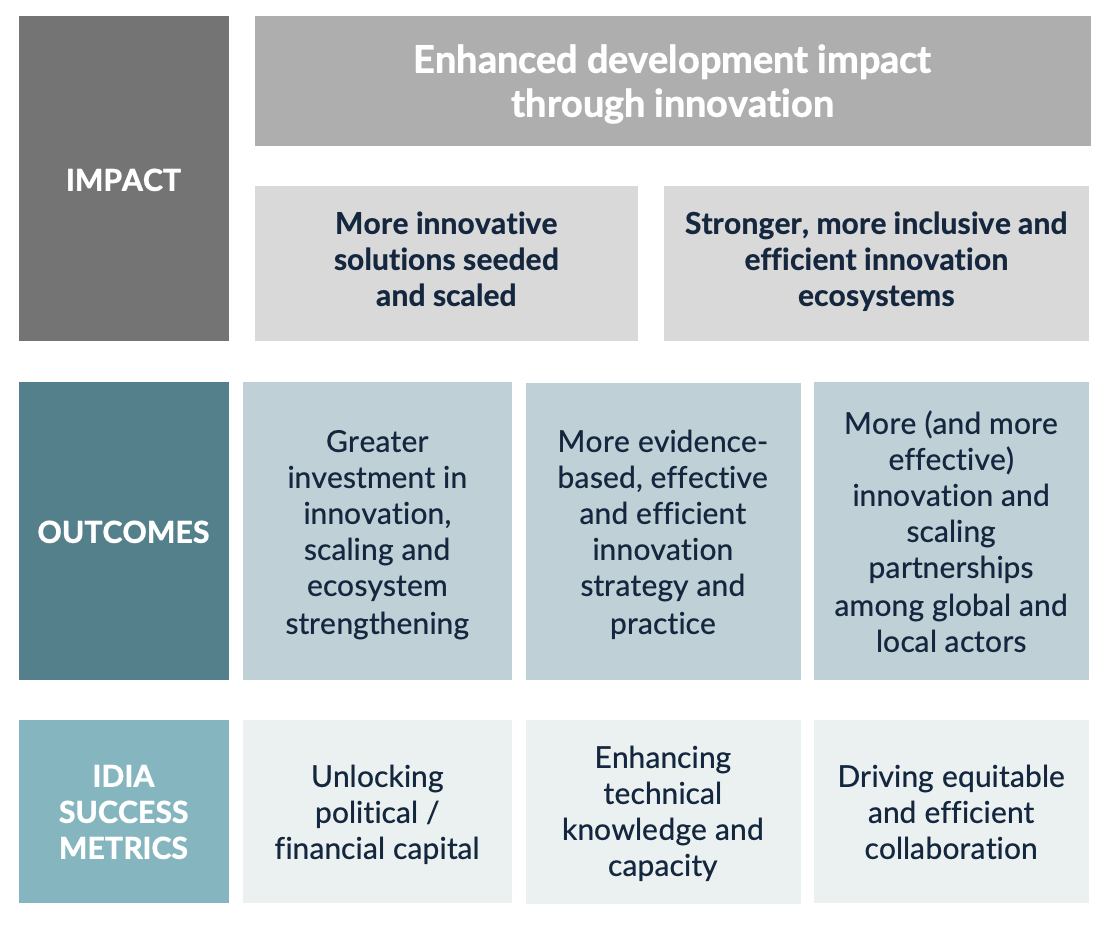
In line with their simple mission to “advance innovation for sustainable development”, IDIA member agencies mobilized their collective voice, expertise, resources and networks to begin shaping a new, enabling environment for innovation across the development sector.
They focused on two high-level, interconnected impact areas:
Seeding and scaling innovative solutions
Creating stronger, more inclusive and efficient innovation ecosystems
They also articulated three specific goals to help measure their contribution:
Unlocking political and financial capital for innovation
Enhancing innovation technical knowledge and capacity
Driving equitable and efficient collaboration across innovation actors
Assembling an ecosystem
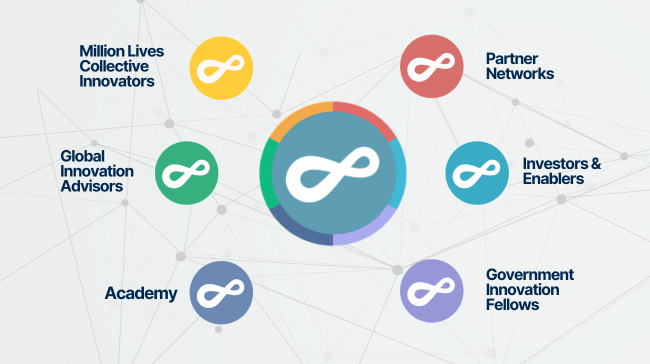
By the end of 2025, the IDIA membership had grown to encompass a diverse variety of actors, reaching far beyond the development agencies who initially established the platform.
Along the way, IDIA had created a community of Global Innovation Advisors across Africa, Asia and Latin America, integrating their contextual and thematic expertise into its governance structure to ensure that Global South priorities and realities are mainstreamed in its strategy and decision making.
IDIA had also established the Million Lives Collective (MLC) – a unique community of innovators and entrepreneurs whose solutions have already reached significant levels of scale, and whose experience and insights could guide IDIA in generating greater, exponential levels of impact.
A unique cohort of Government Innovation Fellows had also formed, bringing together Ministerial Advisors and departmental leads with innovation mandates from multiple countries and continents to support South-South learning and collaboration. This community has since been complemented by IDIA’s Partner Networks - periphery alliances and communities with similar innovation and impact objectives with whom IDIA collaborates to advance mutually beneficial objectives.
Finally, IDIA now included all of the alumni from 30+ countries who had completed the IDIA Managing Innovation for Impact Global Training Programme, and who continued to support each other in advancing innovation leadership within their institutions and wider ecosystems.
The diverse Ecosystem of actors that IDIA had mobilised over its first decade was officially launched in December 2025 at the inaugural IDIA Global Summit, where leaders from each of these communities gathered for three days in Nairobi to forge collective pathways for optimizing the value, resources and expertise that now existed under the global IDIA umbrella.
Invigorated by the determination and potential impact of its Ecosystem members, IDIA is now entering its next decade with an open invitation for other like-minded, committed agencies, organizations and individuals to join us on our evolving journey to advance innovation for sustainable development.