Meeting the moment: Six ways IDIA is shaping the pathway to impact at scale in our new world order
By Thomas Feeny, Director of the IDIA Secretariat
“It’s amazing to think, looking at the challenges we’re now facing, how all of the things that we have co-created through IDIA over the last decade are now more relevant than ever on our journey to scale. The tools, the ways of working and the relationships IDIA has provided are now equipping us to ‘meet the moment’ with confidence. And that’s an amazing return on our collective investment.”
This reflection, recently shared with me by one of the founding members of the International Development Innovation Alliance (IDIA), has been echoed by many of those I have been meeting with in recent weeks. In leading the team at Results for Development (R4D) that co-designed and then managed this unique network since its establishment in 2015, I have had the unique privilege of working closely with IDIA’s wide range of bilateral and multilateral agencies, private foundations, entrepreneurs and government leaders as they navigate the continuing rollercoaster of innovation and development more broadly. Entering 2026, these agencies are experiencing significant change as the scope of their strategies and country partnerships narrows alongside cuts to their financial and human resources (see below).
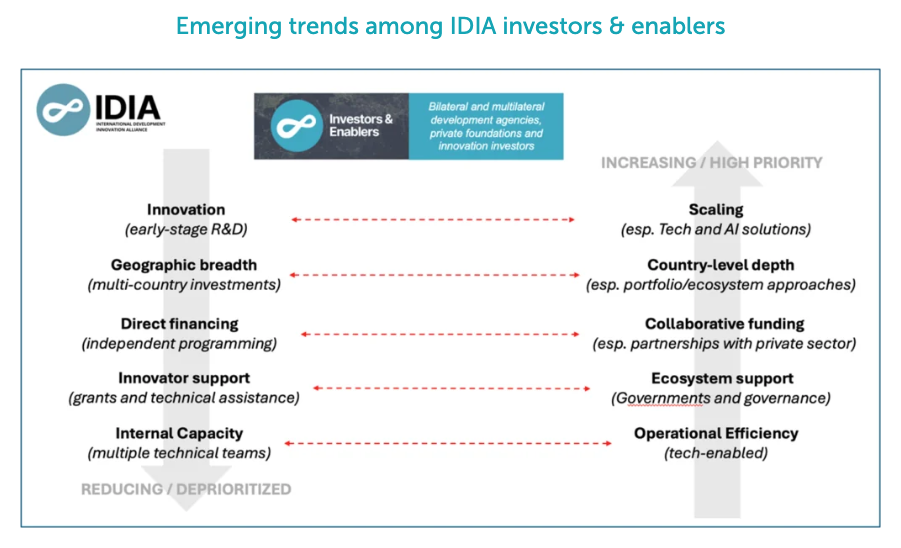
Even the word ‘innovation’ itself appears to be losing currency among the development community — a consequence perhaps of interpretations that prioritized chasing the latest ‘shiny object’ over the harder, longer work of taking proven solutions to impact at scale. But the promise of innovation was never just about new ideas, it was also (and more fundamentally) about new ways of working, and about trying to embed the mindsets and spaces within institutions to allow creativity and experimentation to become the new ‘business as usual’. The shift in emphasis towards later stage scaling is definitely welcome and long overdue, but we must be sure that any current disillusionment with innovation products does not result in us also abandoning the need to continuously challenge and reinvent our innovation practice, which is the key to development remaining relevant and impactful in an ever-changing world.
Scaling — the pathway to impact in the new world order
So far, the first quarter of 2026 has given little cause to celebrate for those in the development innovation community, and there is undeniable, extensive fatigue both within and outside IDIA among those managing these changes and the ongoing fallout of the organizational restructures and cutbacks that characterized last year. However, notwithstanding the risks outlined above we’re also seeing how that fundamental shift in focus from innovation to scaling — the most difficult part of the process — is reflecting courage and a renewed energy, ambition and commitment across the global development community to continue driving this agenda forward.
Scaling is today defined by IDIA as “the process of increasing the reach and impact of a development innovation (or a proven solution) to create sustainable and widespread change within or across geographies and populations in a way that addresses a development problem at the scale of need.”
Scaling has been at the heart of IDIA’s Theory of Change from the very beginning, and the focus of the very first collaboration framework that IDIA co-created in 2017 — a framework that is still proving influential almost a decade later. However, despite widespread acknowledgement of its importance across innovation strategies the world over, the practice of scaling has in reality languished for many years in the “too difficult” box for most agencies, not least because it typically requires a significant commitment of diverse resources over many years to achieve. On the one hand, it may therefore seem ironic — almost foolish — to now be reprioritizing the scaling agenda at a time when institutional resourcing and timeframes for this process are smaller and shorter than they have been for decades. And yet, as was clear from the multi-day workshop I joined last month convening OECD development funders, national innovation agencies from Sub-Saharan Africa, UN agencies and experts from global innovation networks across the world, scaling is now at the top of the agenda for everyone. And not just scaling in isolation, but scaling through ecosystems, recognizing that just as it takes a village to raise a child, it takes an ecosystem to scale an innovation. In fact, working together is, in the current environment, no longer an option but rather a necessity if we are to make any progress in achieving our common vision for a better world.
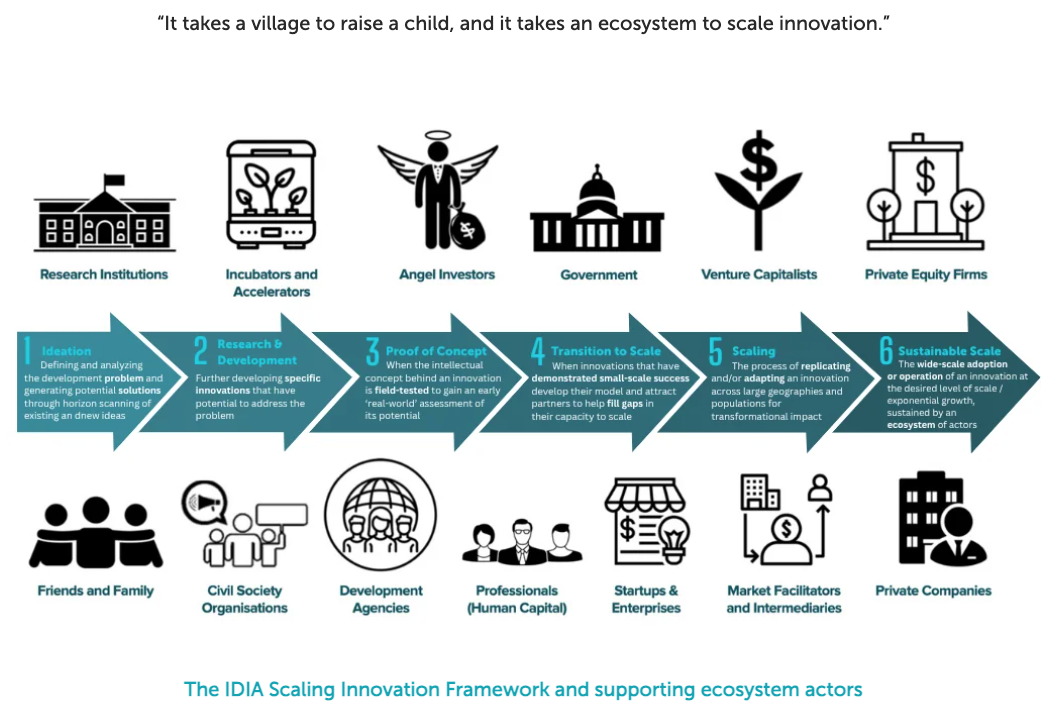
For IDIA, scaling innovation and ecosystem strengthening are two sides of the same coin, and the interdependent impact goals towards which all of our efforts are directed. However, they are more than a concept or an aspirational framework — they are also reflected in the six communities that form the structure of our network and the collective governance that steers our collaboration. They form the basis of the shared principles and values that others such as the G7 have adopted, the common thread underpinning the many tools and frameworks IDIA members and partners have worked hard to create over the last decade to drive more impactful ways of working. They are the reason why the value and relevance of IDIA’s work are now being rediscovered anew by agencies who are looking to equip themselves for scaling in a resource-constrained environment.
Over the course of this three-part blog, my goal is to show how different parts of the ‘toolkit’ and approach that IDIA members have co-created over the last decade are now more relevant for different innovation actors than ever in the new world order. This is not to suggest that IDIA resources are the pinnacle or only choice for those embarking on this difficult journey, but that they can be of benefit in terms of helping synthesize key learning to inform strategy and providing concrete, practical tools to aid scale-up implementation.
Part one looks at ‘the fundamentals’ of developing or refreshing a scaling strategy, highlighting some of the basic frameworks and insights that the IDIA ecosystem has curated as good practice. It also unpacks approaches to harnessing new technologies as an accelerator of scale — and many of the risks that navigating this path involves.
Part two then dives into the practice of scaling through an ecosystem lens, and why this is so critical for sustaining whatever impact you may be achieving. It also explores mobilizing the public sector as a scaling partner through IDIA’s widely adopted “Mountain Model” that has spread rapidly among governments across East Africa, and highlights innovative new approaches to collaborative scaling among innovators who IDIA is helping to cross-fertilize their business models, supply chains and customer bases.
Finally, part three will showcase an exciting new collaboration within IDIA to create a pathbreaking ‘Capital Continuum’ model streamlining the fragmented landscape of innovation financing that entrepreneurs are struggling to navigate. It will also share insights from next month’s meeting of the IDIA ‘Investors & Enablers’ community, who are convening with the specific intention of developing and learning from partnerships for scale around the world.
On behalf of all those in IDIA who have contributed to the resources highlighted in these blogs, I hope you find this series helpful, and as the IDIA ecosystem continues to evolve, we welcome comments, case studies and critiques to help inform our own pathway.
1. The fundamentals: Developing / refreshing a scaling strategy
When IDIA was created in early 2015, a key objective was for its members to begin building shared understandings around the complex practice of development innovation, and where possible collaboratively develop ‘common platforms for supporting innovation from idea to scale, shared learning and improved impact measurement’. Over the years, IDIA has worked with actors and experts all over the world to explore, test and refine approaches to scaling, in the process producing various tools, frameworks, principles and models that can be adapted to different sectors, contexts and innovations.
While these resources have been fundamental in helping different actors connect around a common framework, the intention was not to suggest that all innovation funders should therefore operate in exactly the same way. Different agencies exhibit significant variation in the capacities, constraints and preferences that shape the kind of support they provide and the approach they take, and attempting to create a single framework is neither feasible nor desirable. Similarly, these insights caution against the notion of particular kinds of innovation needing to follow specific scaling pathways, as the flexibility to test and pivot in different directions is an integral part of any scaling journey. A diversity of approaches is important, not least because the scaling process is highly unpredictable, and heavily influenced by the changing social, political, cultural and economic contexts in which an innovation exists. As such, a scaling strategy should always be designed in the context of other actors and then regularly reviewed in line with changing institutional environments and capacities.
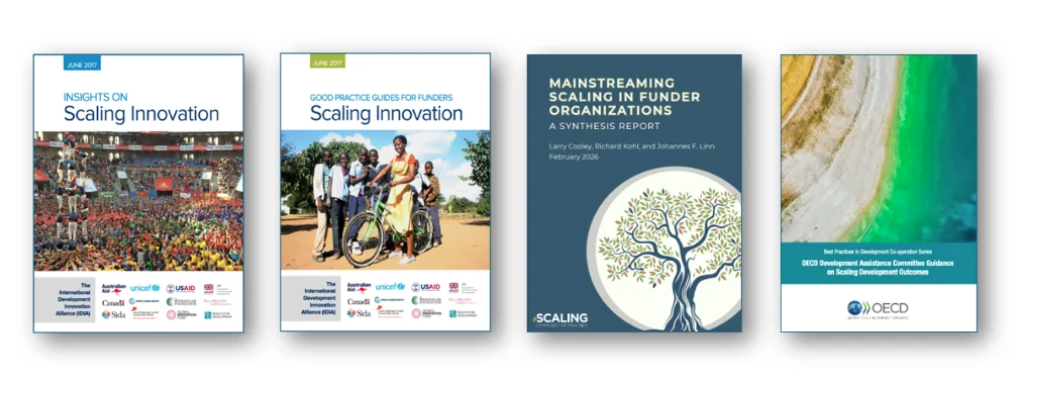
IDIA Insights Guide on Scaling Innovation (2017). This is a great entry-point for agencies building or evolving an organizational strategy for scaling innovation. It provides a broad architecture to help funders in navigating the long and complex process of scaling innovation, while also offering guidance to help innovators and partner organizations develop and enhance their own scaling approaches. Dividing the scaling process into six overlapping stages stretching on a continuum from ideation through to sustainable scale, the framework identifies eight good practices across these stages to help funders of development innovation enhance the impact of their support. It also maps a matrix of Influencing Factors that will either accelerate or constrain the scaling process, with guidance on how funders can use these to initially assess (and then continually monitor) the scalability of an innovation over time.
IDIA Good Practice Guide for Funders in Scaling Innovation (2017). Designed to accompany the core Framework above, this paper in the IDIA Insights series focuses on eight good practices for funders seeking to take promising development innovations to scale. Scaling innovation is far from an exact science and there is no ‘silver bullet’ model guaranteed of delivering impact – similarly, good practice is dynamic and subjective, and will lead to varying levels of success when applied to different contexts and innovations. However, by combining insights from the latest research with the learning and practical experience of both funders and innovators immersed in scaling development innovations, this Good Practice Guide represents a valuable tool for audiences of all backgrounds who are seeking to improve or extend their support in this challenging area.
Mainstreaming Scaling within Funder Organizations (2023-2026). Building off their collaboration in producing the original IDIA Scaling Framework in 2017, members of the Global Community of Practice on Scaling Development Outcomes (a Partner Network of IDIA) came together to produce a series of institutional case studies looking at how well innovation funders were incorporating scaling practices within their work. Specifically, it looks at the structure and experience of 20+ agencies to understand how well they are ‘mainstreaming’ scaling within their mission and strategies; operational policies and guidelines; financing instruments and budgets; staffing practices and incentives; and in their monitoring and evaluation practices.
OECD DAC Guidance on Scaling Development Outcomes (2024). As a Partner Network of IDIA since 2021, the OECD Innovation for Development Facility (INDEF) has been collaborating closely with IDIA to advance the scaling agenda across its members. This resource was produced to provide policy guidance to support decision-makers in DAC member organizations to integrate scaling into the selection and design of projects and programs, and to make scaling a key component of their organizational strategies. It sets out five overarching goals to guide development co-operation providers in scaling development interventions, with each goal supplemented by a brief checklist of possible actions to effectively achieve its objective.
2. Harnessing technology as a key accelerator of scale
For much of the last decade, the innovation strategies of IDIA members were intentionally broad, enabling exploration and experimentation across multiple sectors and different types of innovation, including new policies, financing instruments and partnership models alongside trail-blazing products and services. While this has contributed to a diverse range of global learning and insights, the downside has been a high level of pilots and early-stage solutions, and a recognition of trying to do too much, in too many places with too many people. Today, with many agencies facing heavily diminished resources, the scope of innovation strategies is narrowing. And for a large majority of agencies, those strategies are narrowing primarily around technological innovation, and in particular solutions that are enabled or accelerated by artificial intelligence (AI).
Notwithstanding the tendency in the development community to chase the latest trends and buzzwords, the rapid embrace of technology and AI has a strong rationale from the perspective of scaling impact. It is providing us with unparalleled ability to collect, analyze and monitor data around changing population needs at a level and specificity never before possible; through ever-increasing mobile penetration it is enabling us to reach and interact with people in ways that are not only cheap but almost instantaneous; and through AI algorithms it is driving astonishing time-savings and cost-efficiencies within processes that relied on human effort and capacity. Inevitably, many agencies are now putting all of their scaling bets in the tech and AI basket.
However, there are also not insignificant risks to prioritizing tech and AI, particularly where this excludes support for other kinds of innovation that may be equally impactful in supporting scaling objectives (e.g. policies such as Ethiopia’s recent Start-Up Proclamation which is redefining the legal framework for the recognition, regulation, and support of innovation-driven enterprises). There is also the more fundamental risk of further marginalizing those populations (e.g. rural, refugee, nomadic) who lie outside the reach of the infrastructure, datasets or technological literacy required for tech and AI-related innovations to scale. And this is before considering the widespread and justified concerns African governments have expressed around how the rapid implementation of tech and AI solutions in their countries will impact their ability to manage and protect their national sovereignty in terms of data, compute and talent (see for example, this recent paper by Ambassador Philip Thigo, Kenya’s Special Envoy on Technology and one of IDIA’s Global Innovation Advisors).
Navigating these issues can be daunting, particular for those agencies who lack dedicated internal expertise on tech and AI, and this is where the thoughtful work and practical tools of IDIA can play a role. Under the oversight of a dedicated Emerging Technologies Working Group (ETWG) established in 2018, experts from across IDIA’s global ecosystem of actors have and are continuing to explore this agenda from different angles in line with the priorities our African collaborators have articulated. These include the following resources, developed in partnership with members of the IDIA ecosystem across the world:
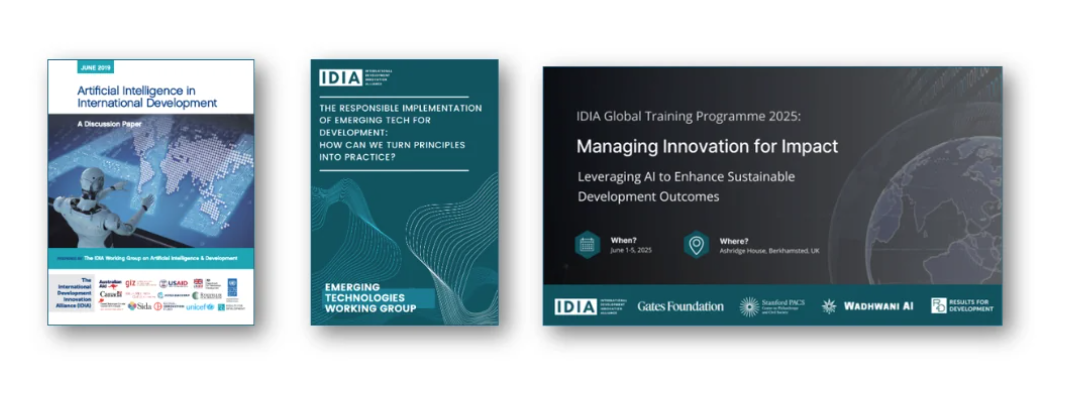
IDIA Insights report on Artificial Intelligence in Development (2019) This early output of the ETWG was designed to help bring agencies less familiar with AI up to speed on its potential application to development challenges, highlighting the direct and indirect risks that unchecked use of this technology may pose. As such, it has proven popular in quickly helping staff of all backgrounds, levels and locations understand the basics of how AI-enabled development interventions are designed, implemented and evaluated.
The Emerging Technologies Resource Navigator (2019-2022) A curated collection of accessible and influential reports, tools and frameworks accompanying the AI in Development report that provide more practical windows into its application. While undoubtedly a product of its time, its value lies in providing trusted repository of entry-points that help cut through the noise and proliferation of resources that are now produced on AI every day.
The Responsible Implementation of Emerging Tech for Development: How can we turn Principles into Practice? (2022) This helps country governments, international partners and ecosystem actors translate the often cryptic and high-level tech principles / ethical frameworks into practice, thereby helping all parties ‘walk the talk’ of responsible design and deployment. It also provides guidance for agencies on ways to define ‘responsible’ in the context of different programming and technology.
The IDIA Emerging Technologies Co-Creation Framework (2023) A practical, step-by-step guide for how different partners can collaborate in creating AI-enabled solutions and ensure greater sovereignty and ownership of the latter by local actors.
The IDIA Adaptive Leadership Course on Leveraging AI to Enhance Development Outcomes (ongoing) This latest iteration of the ever-popular IDIA training course on Innovating for Impact was first delivered in 2025, and provides an immersive, in-depth and cohort-based experience convening expert faculty from across Africa, Asia, the US and UK. A second iteration is planned for 2026, interested participants should visit the website or contact idiatraining@r4d.org to be notified when applications open.
These resources can help agencies to develop thoughtful, locally led strategic responses that optimize the undeniable potential of technology for enhancing development outcomes. Members of IDIA in particular have the added advantage of finessing their tech and AI approach with the benefit of unparalleled access to the strategies and priorities of other funders, governments, innovators and researchers so that the directions they ultimately choose to pursue are informed by a finely-tuned understanding of ecosystem actors and any institutional comparative advantages they may emphasize in response.
This concludes Part One of this blog on “Meeting the Moment”. In Part Two, we will profile additional scaling resources from the IDIA ecosystem, including (a) strengthening country innovation ecosystems; and (b) scaling through governments and innovator to innovator partnerships.