OECD Ecosystem Strengthening Learning Journey Series Session Six
Long-term Horizons: The Role of Innovation in Economic Development Trajectories
Authored by Benjamin Kumpf, Nicole Paul and Shad Hoshyar
This note summarises the discussion of the virtual seminar on 17 February 2026, on innovation ecosystem strengthening, convened for development funders by the OECD Innovation for Development Facility in collaboration with the International Development Innovation Alliance (IDIA). This seminar is part of a nine-month learning journey that aims at advancing peer-learning among funders and generating new insights to inform better practices.
The sixth session of the OECD Innovation Ecosystem Learning Journey focused on Long-term Horizons: The Role of Innovation in Economic Development Trajectories. The session explored how international funders and national partners can think and act beyond programme and project cycles to support innovation ecosystems that contribute to sustainable economic development over 10–15 year horizons. Discussions drew on the case of Senegal’s health innovation and vaccine manufacturing ecosystem, lessons from the global COVID-19 evaluation, and emerging analysis on how multilateral innovation programmes can inadvertently distort the ecosystems they seek to strengthen.
Nicole Paul, from the OECD Innovation for Development Facility, moderated the session. Benjamin Kumpf, also from the Facility, framed the discussion around three conundrums facing DAC members seeking to work towards longer-term horizons, and invited participants to the upcoming in-person conference in Paris on 23-24 March 2026, which will include a technical seminar on ecosystem strengthening and the annual OECD Innovation Community meeting.
Framing: Three Conundrums for Funders
Benjamin Kumpf opened the session by identifying a foundational challenge that is the projectification of development cooperation and three specific conundrums observed across the DAC membership and broader funder community.
First, there is insufficient funding for infrastructure investments among the majority of the members and observers of the OECD Development Assistance Committee seeking to strengthen innovation ecosystems, despite the centrality of roads, electrification, broadband access, and digital infrastructure to ecosystem functioning.
Second, much ecosystem work appears to lack imagination in building out economic niches with national governments, particularly in helping countries develop realistic pathways to becoming producers of relevant technologies grounded in the buildup of human capital, skills, and know-how over 10–15 year horizons.
Third, innovation ecosystem programmes are frequently developed in sectoral silos, without connecting to the planning departments, prime minister’s offices, or economic policy units within partner governments that think about inclusive growth trajectories.
An opening Mentimeter poll revealed that participants considered strong domestic productive and technological capabilities, effective innovation policies, and capable public institutions as the most crucial components for a strong innovation ecosystem in 5–10 years. Most participants indicated they work with a 5–10 year time horizon when developing shared visions with partners, and rated their alignment with longer-term government growth plans as moderate, suggesting room for improvement.
Carving Out Economic Niches: Senegal’s Investments in Its Health Innovation Ecosystem
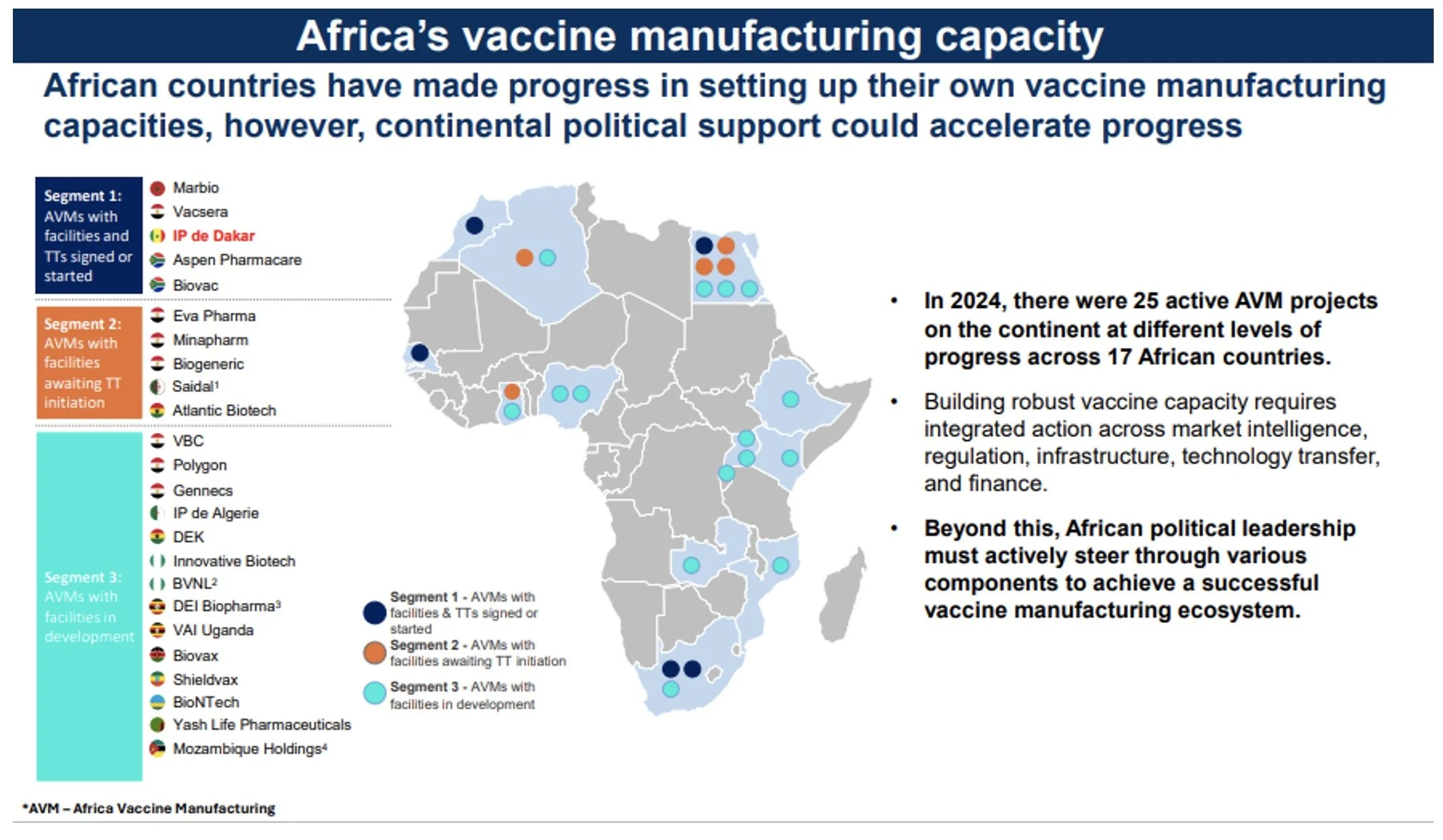
Dr. Josea Rono, CEO of E&K Consulting Firm, presented on Senegal’s deliberate, multi-decade strategy to build a health innovation and vaccine manufacturing ecosystem. He began by situating Senegal within the broader landscape of African vaccine manufacturing, noting that in 2024 there were 25 active vaccine manufacturing projects at different stages of progress across 17 African countries, with Institut Pasteur de Dakar (IPD) among the most advanced. IPD features prominently in UNICEF procurement volumes, particularly for yellow fever and measles-rubella vaccines, demonstrating that Senegal’s investments have achieved meaningful scale.
A number of bilateral funders and members of the OECD Development Assistance Committee (DAC) as well as multilateral development banks, several UN and EU agencies and global innovation funds are implementing programmes and other initiatives specifically aimed at strengthening innovation ecosystems in low and middle-income countries. Many of these initiatives entail support for national partners regarding policy design and implementation.
This session sought to provide an overview of ongoing efforts related to national innovation strategies in selected countries, along with a deep dive in startup acts and in mission-oriented innovation, to share emerging good practices and support further coordination among international funders and with national innovation agencies.
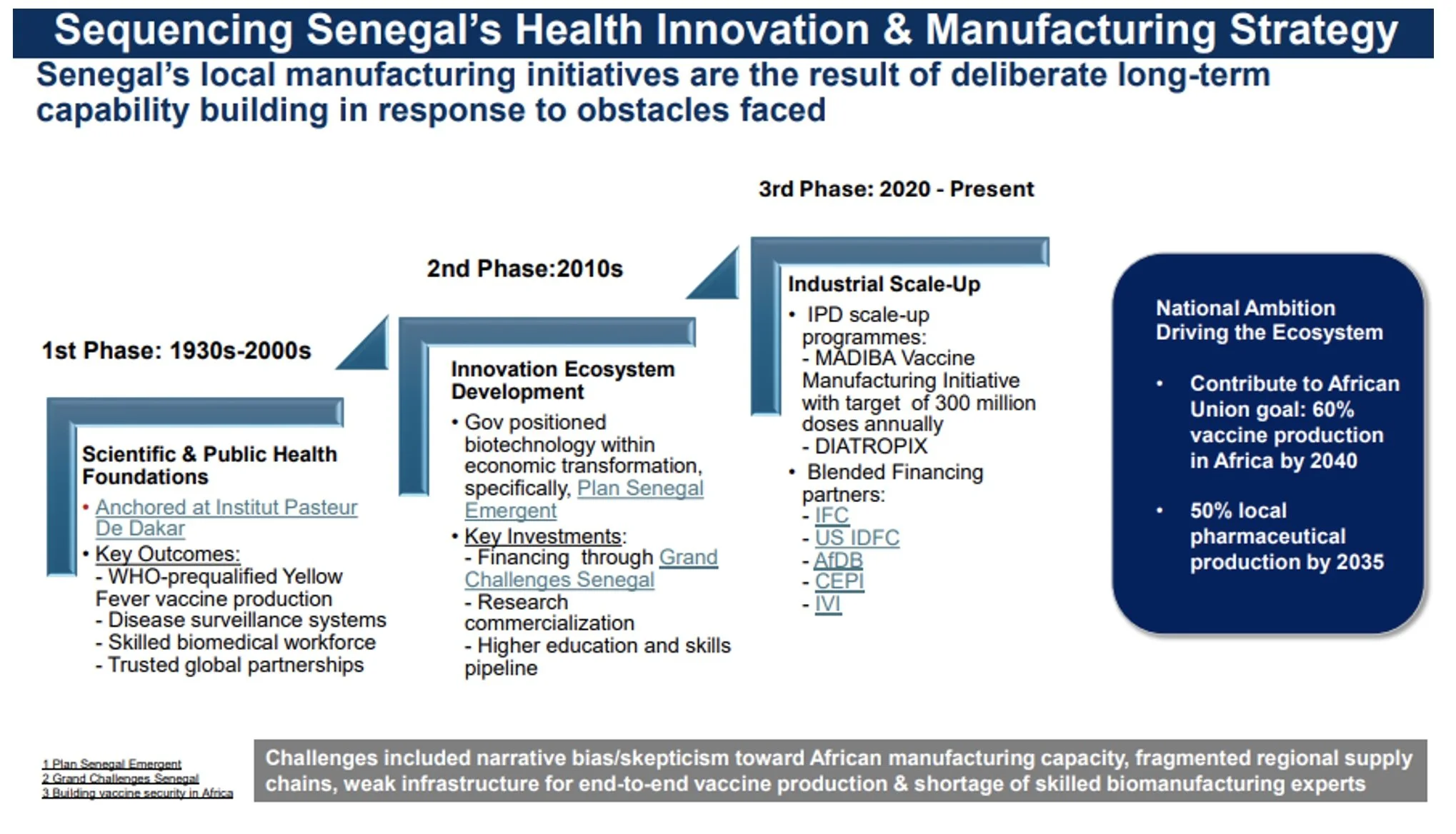
Dr. Rono traced Senegal’s trajectory through three phases. The first phase (1930s–2000s) established scientific and public health foundations anchored at Institut Pasteur de Dakar, producing WHO-prequalified yellow fever vaccines, disease surveillance systems, a skilled biomedical workforce, and trusted global partnerships. The second phase (2010s) saw the government position biotechnology within its broader economic transformation strategy through Plan Sénégal Émergent, with key investments flowing through Grand Challenges Senegal into research commercialisation, higher education, and skills pipeline development. The third phase (2020–present) has focused on industrial scale-up, including the MADIBA Vaccine Manufacturing Initiative targeting 300 million doses annually and the DIATROPIX diagnostics programme, supported by blended financing from IFC, US IDFC, AfDB, CEPI, and IVI.
Dr. Rono highlighted three political economy drivers underpinning Senegal’s success. Workforce development through the MADIBA Workforce Development Initiative, funded by the Mastercard Foundation, established a regional biomanufacturing training hub hosting 300–800 trainees annually, framing manufacturing as an employment and skills strategy rather than solely a health security measure. Public-private collaboration recognised that vaccine manufacturing requires coordinated capabilities across technology transfer, private-sector participation, regulatory strengthening, and workforce development, with industrialisation framed as shared risk and shared investment. State ownership and institutional continuity ensured that investments transcended individual political cycles, with successive governments sustaining commitments aligned with the national plan.
He also noted the role of continental support mechanisms such as the Africa Vaccine Manufacturing Accelerator (AVMA), which provides milestone and accelerator payments to African manufacturers achieving WHO prequalification and winning UNICEF tenders. Senegal’s national ambition, contributing to the African Union goal of 60% vaccine production in Africa by 2040 and 50% local pharmaceutical production by 2035, provides directionality for the ecosystem.
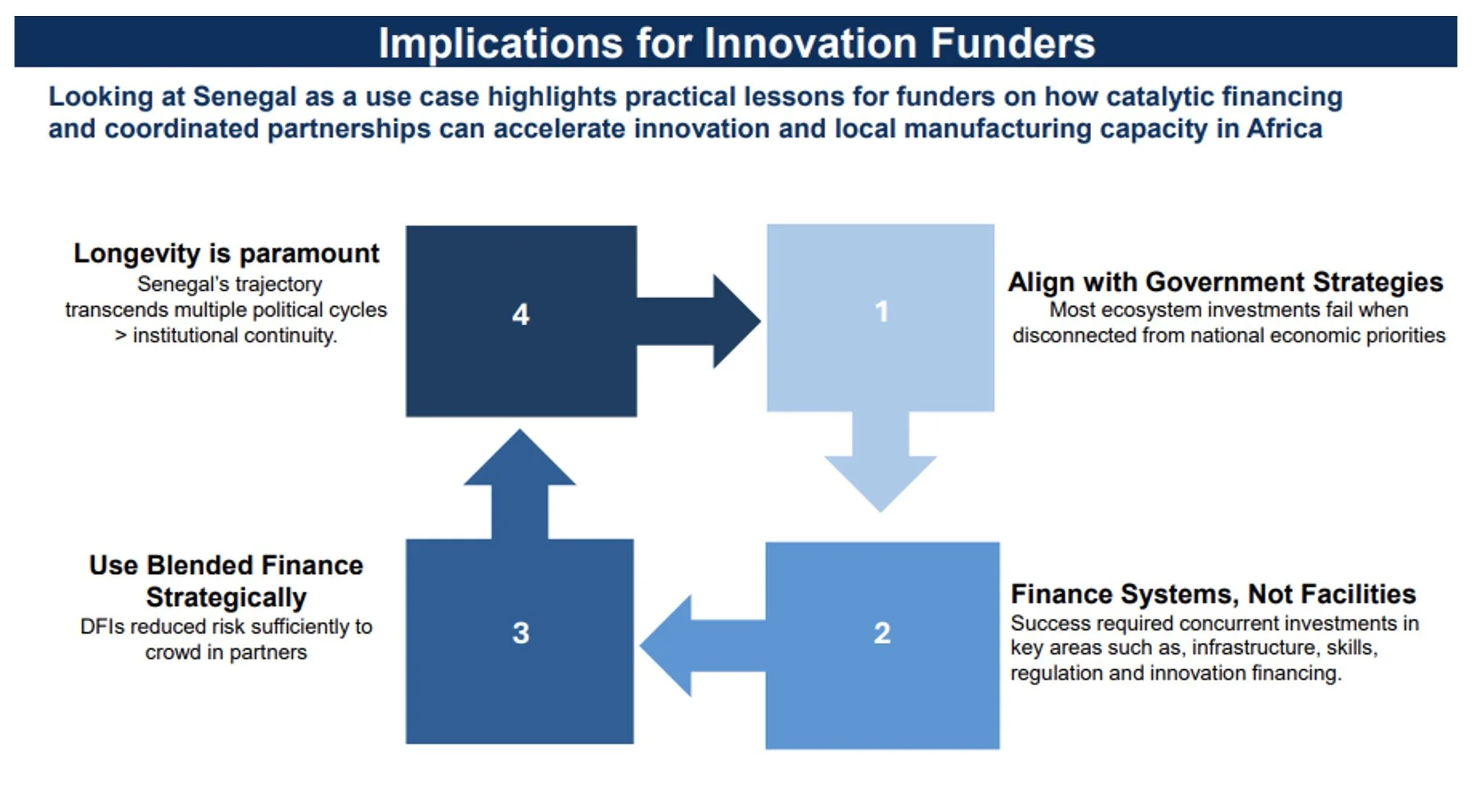
Dr. Rono concluded with four implications for innovation funders: align with government strategies, as ecosystem investments fail when disconnected from national economic priorities; finance systems rather than facilities, investing concurrently in infrastructure, skills, regulation, and innovation financing; use blended finance strategically, as DFIs reduced risk sufficiently to crowd in partners; and prioritise longevity, recognising that Senegal’s trajectory transcends multiple political cycles through institutional continuity.
Lessons from the Global COVID-19 Evaluation
Benjamin Kumpf shared key findings from the work of Megan Kennedy-Chouane, Head of the Evaluation Unit at OECD, on the Global COVID-19 Evaluation Coalition. He highlighted that innovation played a significant role in the direct crisis response, particularly in addressing breakdowns in supply chains for personal protective equipment and vaccine shortages that led to global inequity. However, many countries saw a rollback on innovative practices after the acute crisis phase, returning to business as usual rather than sustaining the accelerated experimentation that characterised the response.
Benjamin highlighted three takeaways. First, investing in innovation ecosystems has direct relevance for pandemic preparedness, as countries with strong ecosystems were better equipped to respond. He illustrated this with the case of decentralised maker spaces in Delhi that stepped up during the 2020 shutdown to produce personal protective equipment at scale, after having been overlooked by local government for years, partnerships that have since been formalised. Second, there was a strong argument for generic investments in innovation ecosystems, not limited to the health sector. Third, the evaluation reinforced the importance of focusing on national production capabilities, including for vaccines, as another reminder of the necessity of longer-term outlooks.
When Multilaterals Compete: Market Distortion in Innovation Ecosystems
Scott Walker, Founding Partner and CEO of Systemic Innovation, presented findings from a recently published analysis examining how vertically integrated UN innovation programmes can shape, and sometimes substitute for, intermediary markets. He emphasised that the analysis was not anti-UN but rather questioned whether governance arrangements adequately match the unique privileges and responsibilities of multilateral institutions operating within innovation ecosystems.
The unit of analysis was the innovation intermediary market, the actors who select ventures, run accelerators, broker partnerships, and validate solutions, rather than individual startups or single programmes. Walker identified a recurring pattern across UN innovation portfolios: institutions step in to reduce risk and coordinate fragmented ecosystems, but over time this catalytic intervention evolves into integrated delivery, where one programme funds, convenes, delivers, and validates. This creates what the analysis terms “role collapse,” where functions that would normally be separated across funder, designer, operator, standard-setter can sit within a single organisation.
Walker argued that the resulting “bundled advantage” - combining concessionary finance, privileged access to ministries and donors, and insulation from failure - replaces competition without explicit exclusion. A local intermediary or accelerator may be technically strong but cannot compete on equivalent terms when funding, access, and validation are all bundled together. Critically, this distortion appears as absence rather than programme failure: outputs may look strong and activity may be high, but independent intermediaries may not survive without donor backing, and the ecosystem becomes “programme-rich but capability-thin.”